

Horses evolved to graze for most of the day. Their stomach is small for their size, and their digestive system works best with a steady flow of food rather than two big meals. That is why equine nutrition specialists put so much weight on how often and how much a horse eats at one time, not only on what it eats.
Start with forage
Hay or pasture should make up the base of every horse’s diet. University of Georgia and University of Florida extension specialists recommend a minimum of 1% of body weight per day as forage (dry matter basis), and preferably 1.5% to 2%. For a 500 kg horse, that is at least 5 kg of forage a day, and ideally 7.5 to 10 kg.
Forage keeps the horse chewing, and chewing produces saliva that helps buffer stomach acid. It also feeds the microbes in the hindgut that digest fibre.
Keep grain meals small
Grain and other concentrates are dense in starch. When a large concentrate meal arrives at once, the small intestine cannot digest all of the starch, and the excess reaches the hindgut, where it can upset the microbial balance and raise the risk of colic.
The guidance from extension services is consistent:
- University of Georgia Extension: limit each grain meal to less than 0.5% of body weight. A 500 kg horse should get no more than 2.5 kg of grain in one meal.
- eXtension HorseQuest: once daily grain goes above 0.5% of body weight, split it into two or three feedings.
- Auburn University (Alabama Extension): if concentrate goes above 0.75% of body weight a day, split it into at least two meals. Above 1.5%, use three or four meals about 8 hours apart.
How many meals a day?
For a stabled horse, the minimum is two feeds a day at evenly spaced times. Horses in hard work, growing horses and broodmares often need more concentrate, and that is when three or four smaller meals make a real difference. The same total amount, split into more meals, is easier on the digestive system.
The practical problem is that each extra meal is another trip to the stable, often early in the morning or late at night. That is where many feeding plans break down.
Feed by weight, not by scoop
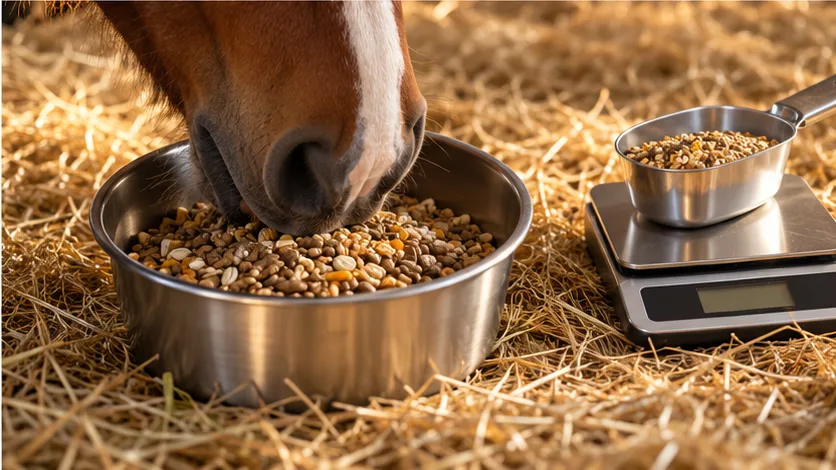
Feeds differ in density, so one scoop of pellets does not weigh the same as one scoop of sweet feed. Auburn University recommends weighing feed with a simple kitchen or hanging scale. Once you know the weight of your usual scoop for each feed, portions become far more consistent.
A simple checklist
- Offer forage first, at least 1% of body weight a day.
- Keep each grain meal under 0.5% of body weight.
- Split larger grain rations into three or four meals.
- Feed at the same times every day.
- Weigh feed instead of estimating by volume.
- Ask your vet or an equine nutritionist to set the right ration for each horse.
How AK Feeder helps: an automatic feeder can serve several small, measured concentrate meals a day at fixed times, without extra trips to the stable. See automatic vs traditional feeding for a side-by-side comparison.
Sources
- Duberstein, K. J. and Johnson, E. L. Basic Nutritional Guidelines for Equine Management. UGA Cooperative Extension Bulletin 1356
- eXtension HorseQuest. Feeding Frequency for Horses
- Walker, M., da Silva, L. and Dillard, L. 10 Rules for Feeding Horses. Alabama Cooperative Extension System, ANR-1355
This article is general information and does not replace advice from your veterinarian or equine nutritionist.